
Best Conference Venues in London for Event Planners
For corporate conferences in London, these are the venues worth shortlisting right now:
- Central Hall Westminster — purpose-built, high-capacity plenary space in the heart of Westminster
- De Vere Grand Connaught Rooms — Grade II-listed halls on Great Queen Street, ideal for prestige events and awards
- The Brewery — large, flexible halls at 52 Chiswell Street, City/Barbican, suited to industry gatherings
- Evolution London — warehouse-character space near Chelsea Bridge for creative or brand-led conferences
- One Great George Street — period interiors in Westminster for government and professional services events
- Cavendish Venues, 22 Duchess Mews W1 — well-equipped W1 meeting suites for board sessions and workshops
- Woburn House Conference Centre — Bloomsbury, close to academic institutions, strong for institutional events
- Regent's Events — campus-style rooms at Regent's University, Inner Circle, Regent's Park
- The Central Conference & Events Venue — compact, well-rated space at 42 Hallam Street, W1
The single action that accelerates your selection: send a precise written brief to each venue before requesting proposals. It keeps responses comparable and eliminates wasted site visits.
Pro Tip: Before you contact a single venue, write down your delegate count, event date, format (plenary only, plenary plus breakouts, hybrid), AV requirements, and any accessibility needs. Venues that cannot meet your brief will self-select out immediately.
Table of Contents
- Which London conference venues suit your event?
- What accessibility questions should you ask every venue?
- How does layout affect your conference format?
- What on-site facilities should you confirm before booking?
- How do you move from shortlist to signed contract?
- Key takeaways
- What a photographer notices that planners sometimes miss
- Professional event photography for your London conference
Which London conference venues suit your event?
| Venue | Type | London submarket | Best for | Standout | Google reviews |
|---|---|---|---|---|---|
| Alex Gell Photography | Event photography | Berkshire / London-wide | Event photography & PR imagery | Documentary-style commercial coverage with fast turnaround | 5★ (3) |
| Central Hall Westminster | Purpose-built conference centre | Westminster | Large corporate conferences, plenaries | High capacity, iconic central location | 4.6★ |
| De Vere Grand Connaught Rooms | Historic events venue | West End / Holborn | Prestige conferences, award ceremonies | Grade II-listed halls, Great Queen Street | 4.2★ |
| The Brewery | Conference centre | City / Barbican | Industry gatherings, large corporates | Flexible halls for exhibitions and plenaries | 4.5★ |
| Evolution London | Conference centre | South West / Chelsea Bridge | Creative, brand-focused conferences | Warehouse character, adaptable layouts | 4.5★ |
| One Great George Street | Conference centre | Westminster | Government, professional services | Historic interiors, formal plenary rooms | 4.6★ (715) |
| Cavendish Venues, 22 Duchess Mews | Meeting suites | West End / Marylebone | Board meetings, breakout sessions | Cluster of well-equipped W1 suites | 4.6★ (425) |
| Woburn House Conference Centre | Conference centre | Bloomsbury | Academic and institutional events | Near universities, Tavistock Square | 4.3★ (202) |
| Regent's Events | Campus conference centre | North London / Regent's Park | Smaller academic or training events | University campus, lecture-hall rooms | 4.6★ (57) |
| The Central Conference & Events Venue | Conference centre | West End / Fitzrovia | Boutique conferences, private sessions | Compact W1 location, personalised service | 4.7★ (13) |
The day delegate rate (DDR) is the standard pricing model across London's conference venues. It typically bundles room hire, standard AV, lunch, and two refreshment breaks. What it usually excludes: dedicated event staffing, security, specialist AV beyond the basics, and high-speed internet upgrades. Always request a full exclusions list before signing.
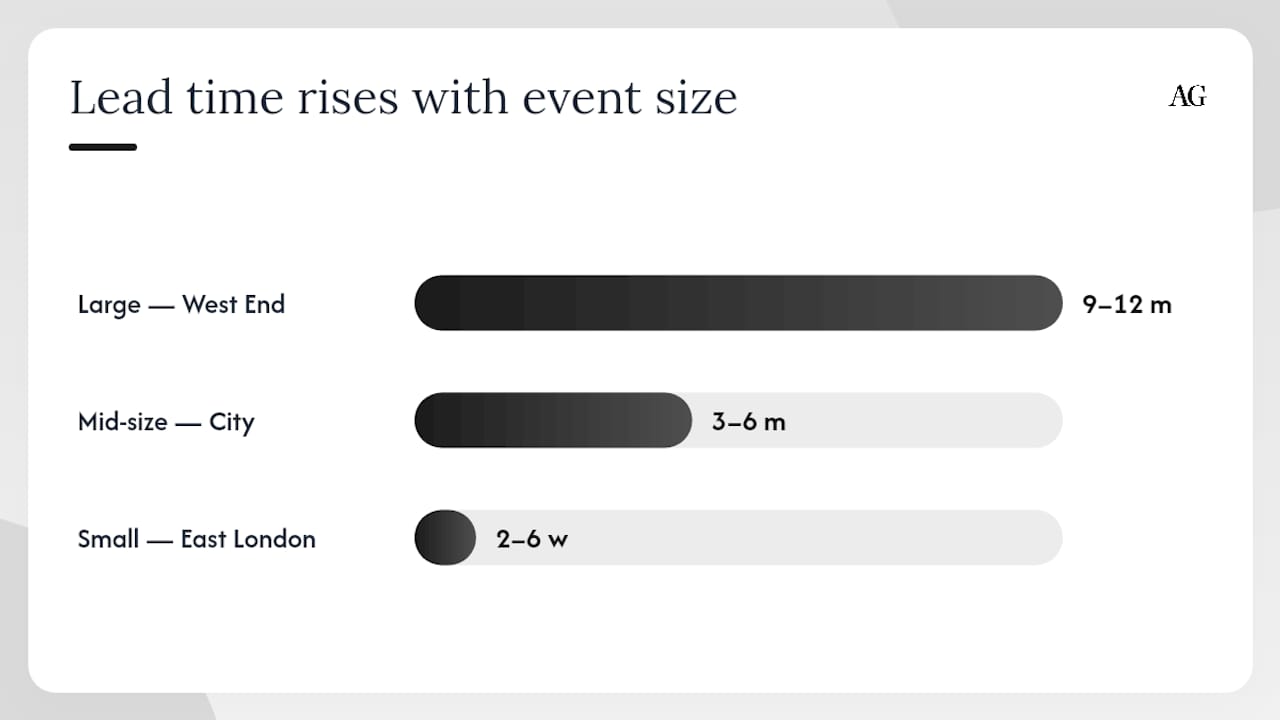
Booking lead times vary significantly by event size: large conferences of 300 or more delegates need 9–12 months for a first-choice venue; mid-size events typically require 3–6 months; small meetings can often be arranged in 2–6 weeks. Q4 dates fill fastest across all categories.
Geography matters too: Different London areas tend to attract different event audiences: City and Canary Wharf favor finance sectors; West End and Westminster provide prestige and connectivity; East London and Shoreditch appeal to creative and tech delegates.
Pro Tip: Build a standardised site-visit scorecard before you tour venues. Score each one on delegate flow, mid-day room transitions, breakout logistics, natural light, and AV infrastructure. Aesthetic impressions fade; a scored comparison does not.
What accessibility questions should you ask every venue?
Generic assurances are not enough. Accessibility must be verified at a granular level for every event. Ask these specific questions on every site visit:
- Is the step-free route continuous from the street entrance to the exact meeting room, including any breakout spaces?
- Is a hearing loop installed in the main conference room, and has it been tested recently?
- Are accessible toilets located on the same floor as the event spaces?
- Where is the accessible parking or drop-off point, and how far is it from the entrance?
- Can the venue provide a written accessibility statement covering all event floors?
Historic venues such as De Vere Grand Connaught Rooms and One Great George Street carry particular risk here. Period architecture often means lifts were retrofitted and step-free routes are indirect. Verify the actual route, not the brochure claim.
How does layout affect your conference format?
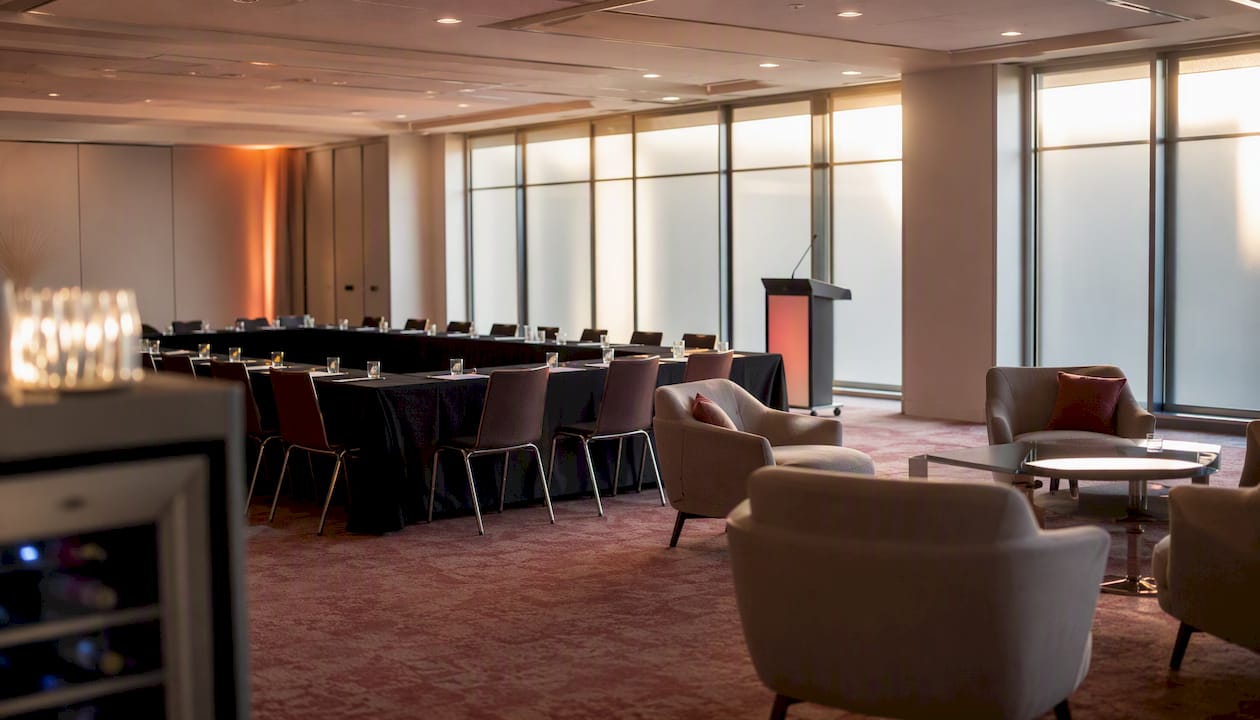
Capacity figures alone mislead. A room that holds 400 in theatre style may hold only 180 in cabaret. Match the layout to your format before you shortlist.
Theatre style maximises delegate numbers for keynote-heavy programmes. Central Hall Westminster and The Brewery both offer large theatre-style plenaries suited to 300-plus audiences.
Cabaret and boardroom layouts suit interactive workshops and smaller leadership sessions. Cavendish Venues' W1 suites and Woburn House are well-configured for these formats, with rooms that scale down without feeling empty.
Hybrid formats need more than a camera on a tripod. Confirm dedicated upload bandwidth, a production area for the streaming team, and sightlines that work for both in-room and remote audiences. Evolution London's flexible warehouse layout gives production teams the space to set this up properly.
What on-site facilities should you confirm before booking?
Parking in central London is limited. Central Hall Westminster, One Great George Street, and The Brewery are all well-served by public transport, which is often the more practical answer for large delegate numbers. For events where driving is expected, confirm nearby NCP or venue-arranged parking in writing.
Accommodation proximity matters for multi-day events. Westminster and West End venues sit within walking distance of a wide range of hotels. Regent's Events on the Inner Circle offers on-campus accommodation options, which simplifies logistics for residential conferences.
Catering arrangements vary. Some venues operate exclusively with their in-house caterer; others permit approved external suppliers. Clarify this early, particularly if you have complex dietary requirements or a preferred catering partner.
How do you move from shortlist to signed contract?
Follow these steps in order:
- Send your written brief to three to five venues simultaneously.
- Review proposals against your brief criteria, not just price.
- Conduct site visits with your scorecard; bring your AV lead if hybrid is involved.
- Request a detailed contract covering cancellation terms, force majeure, minimum spend, and liability.
- Negotiate on value-adds before price: complimentary AV upgrades, additional breakout rooms, or extended access hours are often easier to secure than a rate reduction.
- Confirm insurance requirements in writing; most London venues require public liability cover from the organiser.
- Sign with a clear payment schedule and retain a copy of all agreed inclusions.
Read cancellation clauses carefully. Many London venues retain a percentage of the total fee on cancellation within 90 days. Know your exposure before you commit.
Key takeaways
London's best conference venues reward planners who brief precisely, book early, and verify accessibility in person rather than on paper.
| Point | Details |
|---|---|
| Book early by event size | Large events (300+) need 9–12 months; mid-size 3–6 months; small meetings 2–6 weeks. |
| DDR rarely covers everything | Confirm exclusions: staffing, security, specialist AV, and high-speed internet are commonly additional. |
| Verify accessibility in person | Step-free routes, hearing loops, and accessible toilets must be confirmed for the exact event floor. |
| Match location to audience | Westminster and West End for prestige; City for finance; East London for creative and tech delegates. |
| Alex Gell for event imagery | Alex Gell covers London conferences with documentary-style photography and fast PR turnaround. |
What a photographer notices that planners sometimes miss
There is something I have observed across many corporate events in London and Berkshire: the venues that photograph beautifully are almost always the ones that flow well for delegates too. Good natural light, clear sightlines, and logical arrival routes are not just photographic concerns. They are the conditions that make an event feel considered and professional.
When I arrive at a venue for a London event shoot, I am checking the same things a sharp event planner should check: where does natural light fall during the keynote hours, are there dedicated spaces for networking photography away from the main stage, and does the entrance sequence give delegates a moment to arrive rather than funnel them straight into a crowd?
Historic venues like One Great George Street and De Vere Grand Connaught Rooms offer extraordinary visual character, but their period layouts can create pinch points. Flexible spaces like Evolution London give production and photography teams room to work, which translates directly into better imagery and a smoother delegate experience.
The brief you send to a venue is also, in effect, a brief for the story you want told in photographs. The more specific you are about format, flow, and key moments, the better every supplier, including your photographer, can prepare.
Professional event photography for your London conference
Choosing the right venue is only part of the picture. The imagery from your conference is what lives on in press coverage, social media, and internal communications long after the day itself.
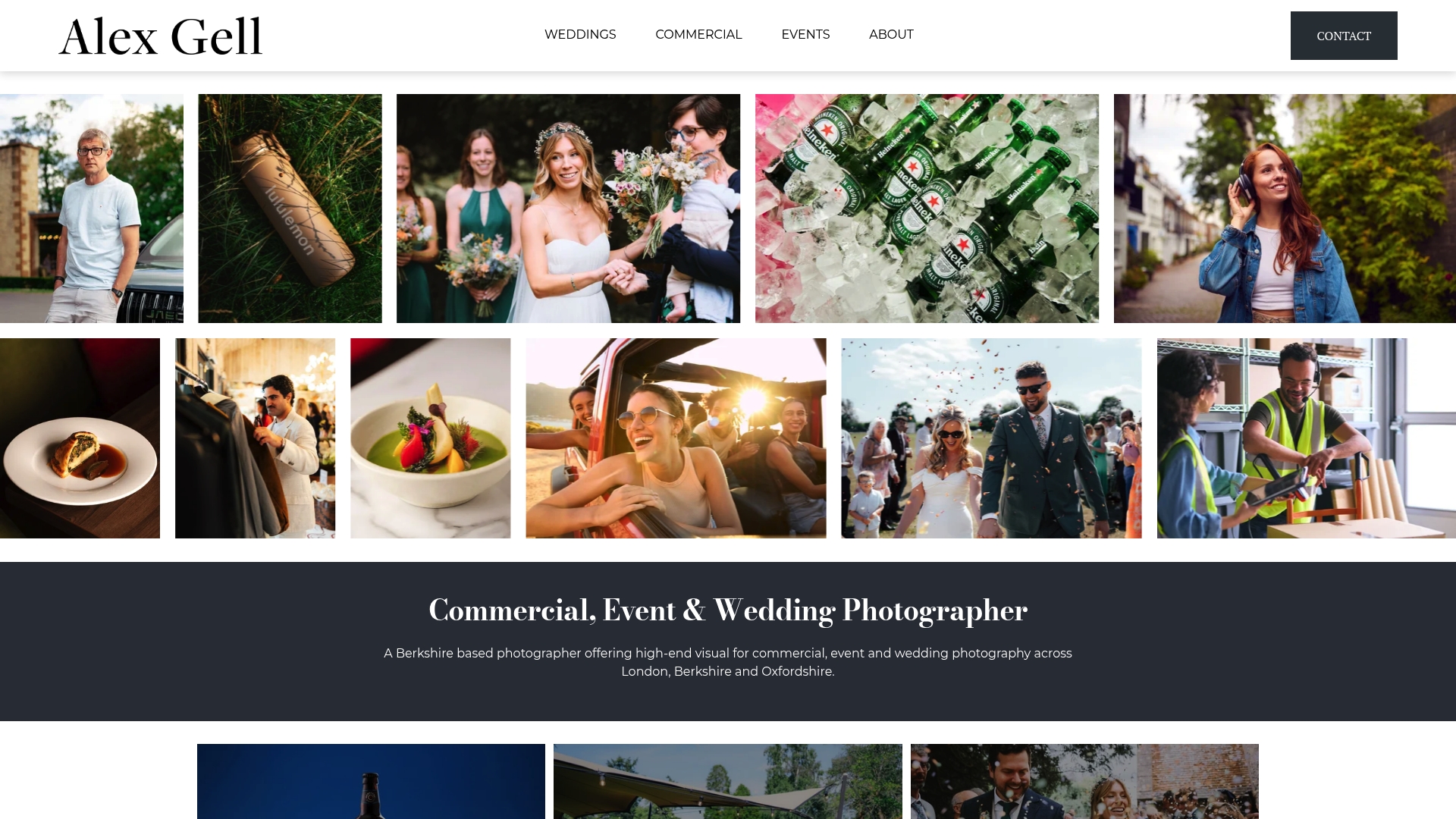
Alex Gell covers corporate conferences across London with a documentary-style approach that captures real moments: keynote speakers in full flow, genuine delegate reactions, and the details that communicate your brand. Fast-turnaround galleries mean your PR team has usable assets the same day or next morning. Commercial licensing options are available for marketing and press use.
If you are planning a London conference and want photography that genuinely reflects the quality of your event, get in touch to check availability or view the corporate and event portfolio for examples of recent work.
